
Your guests can check in on any floor.
Can they all get out?
A hotel is a public accommodation. Under the ADA you're obligated to have a way to evacuate a mobility-impaired guest when the elevators lock out — and most hotels have a line in a binder and nothing in the stairwell. Outpost closes that gap: the chair, the sling, the trained night crew, and the documentation, in one deployment.
The obligation is on you — whether or not there's a chair in the stairwell.
DOJ's Title III manual (§III-4.2100): a public accommodation “is obligated to modify its evacuation procedures… to provide alternative means for clients with mobility impairments to be safely evacuated.”
The nationwide Hilton consent decree (2010, ~900 hotels) required staff training on emergency procedures for guests with disabilities; the Bass Hotels settlement was the first of its kind.
Areas of refuge aren't required in fully-sprinklered high-rise hotels, which is exactly why assisted stairwell descent is the fallback that has to actually work.
Every hotel fire that rewrote the rules has the same shape: people cut off above the fire.
Guests on the upper floors of the 21-story tower were cut off when smoke poured through the stairwells and air ducts. The disaster that drove modern high-rise sprinkler and egress law.
The “fireproof” 15-story hotel had a single interior stairway and no fire escapes; ladders reached only the 8th floor. It catalyzed modern life-safety codes.
Locked exits turned an escapable fire into an entrapment — the enduring lesson that the people who can't move fast are the ones who don't get out.
Nothing undoes these losses. But every one ends the same way — people who couldn't take the stairs, with no way down once the elevators shut off. A stairway evacuation chair in every guest-floor stairwell, and a transfer sling to reach the guest who can't get to it, is the capability that gives those people a path to the exit. That readiness is the entire reason Outpost exists.
Sources: NFPA / USFA investigation reports; contemporary reporting. Framed as vertical-egress failure; we never claim specific victims were disabled.
Carried down 69 floors — and lived.
On 9/11, John Abruzzo, a quadriplegic Port Authority accountant, was on the 69th floor of the North Tower. Colleagues placed him in a stairway evacuation chair and took turns carrying him down all 69 flights in about ninety minutes. He survived. In the 1993 bombing — before the chairs were staged — the same descent took roughly six hours. One piece of equipment in the stairwell was the difference.
Equipment, training, and proof — in one deployment.
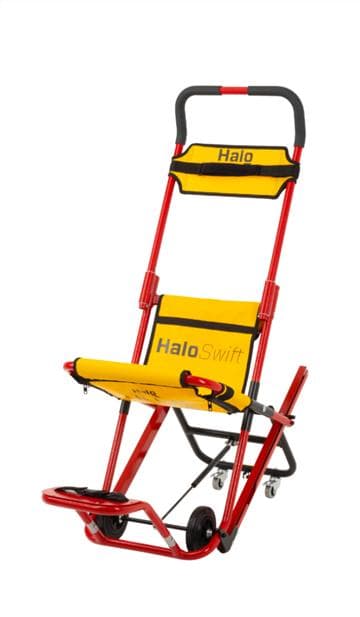
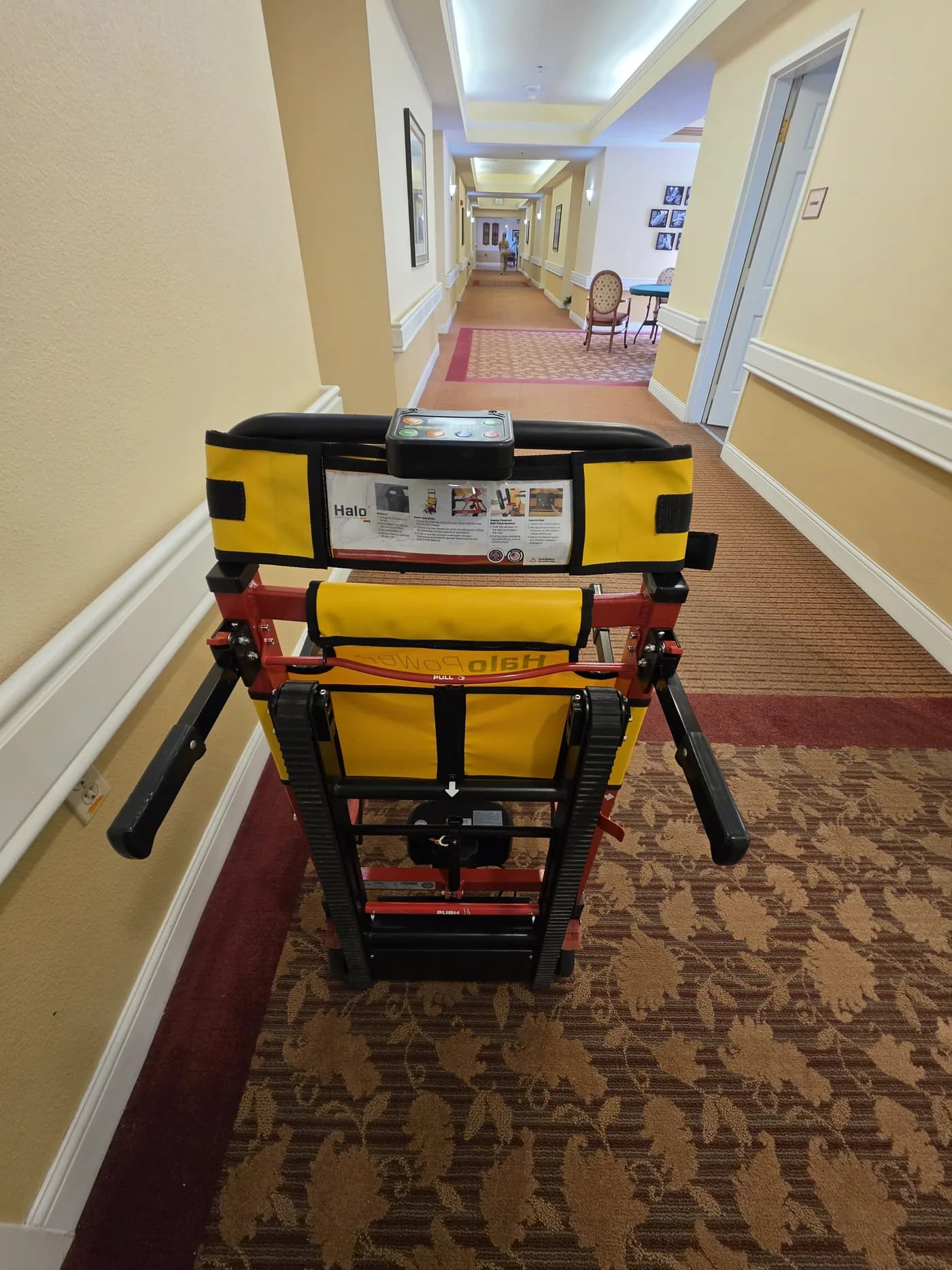
- HALO evacuation chairsOne per guest-floor stairwell — the manual Swift for a typical tower, the powered Power where a high-rise needs ascent as well as descent.
- ProMove transfer slingsSo your night crew can move a guest who can't self-transfer into the chair — safely, with dignity, without lifting.
- Hands-on staff trainingEvery shift practices with the real equipment on your actual stairs — certified and logged.
- Outpost Go-Bag & SunCaseStaged at the front desk / fire command point: light, gloves, route-marking, and backup power that keeps a Power chair and comms running.
- Quarterly drillsScheduled, documented drills that keep the capability real between inspections.
- 12-month audit logThe binder an ADA reviewer, fire marshal, or insurer asks for — dates, names, serials, signatures.
Get the Hotel readiness flyer
The obligation, the highlights, and a stairwell-readiness checklist — on one page you can forward to your team. We'll email it now.
Build your coverage in 30 seconds
Set your building, pick your chairs, and watch three tiers of coverage price themselves.
The ADA expects a way down for every mobility-impaired guest — a chair in each guest-floor stairwell is the baseline.
Estimate only — final counts confirmed on your walkthrough. Chairs & slings are quoted; Go-Bags and SunCase are priced online.
Tell us the property. We'll send the spec.
One-page spec and a fixed price for your hotel — no call required.
The chair lives on the floor the guest is on.
A folded HALO chair in a hotel corridor, and the same chair taking a passenger down a staircase. Both filmed by us, not supplied by a catalogue.
We wrote this one up in full.
Source-cited, no pitch, free to read. If you want to know whether this is a real problem before you talk to anybody, start here.
All field notes →